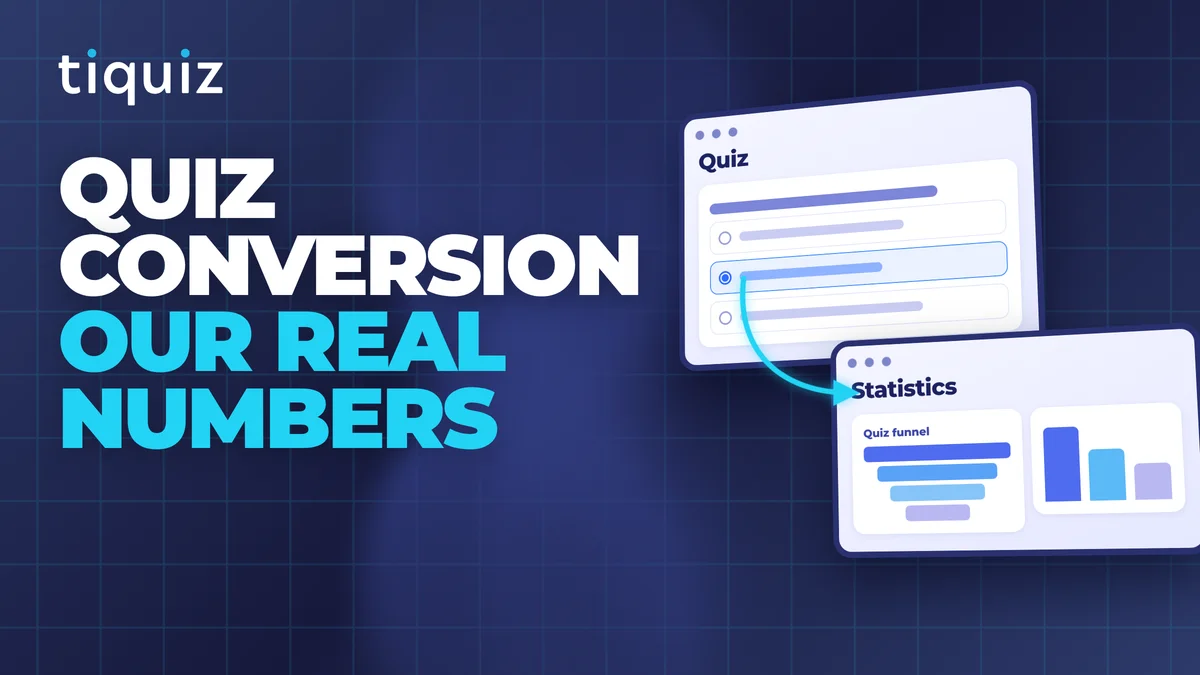
When you look up quiz conversion rates, you mostly find numbers published by quiz tools about their own customers. I built Tiquiz, so I did the same with our data: every view, every quiz start, every email left, over a full month.
You get the raw numbers, how they are counted, and what they can't prove.
Quiz conversion rate, step by step
| Step | Count | Rate |
|---|---|---|
| Quiz views | 6,735 | |
| Quiz starts | 4,354 | 64.6% of views |
| Quiz completions | 3,433 | 78.8% of starts |
| Emails left | 2,184 | 50.2% of starts |
You can read this table three ways, depending on your question:
- Out of 100 people who start a quiz, 50 leave their email.
- Out of 100 people who finish it, 64 leave their email.
- Out of 100 people who see the first page, 32 leave their email.
The number compared from one tool to another is the first one: the share of people who start a quiz and leave their email. It is also the fairest, because it doesn't depend on the quality of the traffic you send to the page.
A quiz conversion rate that can double from one quiz to the next
An average hides gaps. Across the 12 quizzes that were started at least 30 times during the period:
- the middle quiz converts at 49.1%;
- a quarter of the quizzes are below 34%;
- a quarter of the quizzes are above 60%.
Same tool, same mechanics, and a result that can double. The difference is in the quiz itself: its topic, its questions, and what it promises when it asks for the email.
What these quiz conversion numbers don't say
- The sample is small. 73 quizzes were started at least once, but 12 quizzes account for 4,027 of the 4,354 starts. A few very active quizzes weigh heavily on the average.
- It's one month, on one tool. Tiquiz users are mostly French-speaking coaches, course creators and freelancers. Another audience would give other numbers.
- Not every quiz asks for an email. Those that don't count in quiz starts, not in emails: they pull the rate down.
- An email is not a sale. These numbers stop at capture. What comes next depends on your emails and your offer.
Our quiz conversion rate next to Interact's report
Interact publishes the same metric on its customers' quizzes: 40.1% of people who start a quiz leave their email (report updated September 8, 2026).
Both numbers are in the same range: four to five people out of ten. They can't be compared to the decimal: the periods, the audiences and the number of quizzes differ, and Interact's sample is much larger than ours.
Keep the order of magnitude: when someone starts a quiz, there is roughly a one in two chance they leave you their email.
Why so many people leave their email in a quiz
Three reasons show in the table:
- Starting is easy. Answering a first question costs nothing: 64.6% of visitors do it.
- People finish. Once started, they want to reach the end: 78.8% complete.
- The email comes at the right moment. It is asked right before the result, when the person wants to know. They don't trade their address for a promise, but for an answer about themselves.
The full mechanics are in what is a quiz funnel.
Measure your quiz conversion rate in Tiquiz
In Tiquiz, your quiz's statistics tab shows views, starts, completions and leads, then the path question by question: you see where people stop. The walkthrough is in how to read your quiz stats.
To place yourself:
- Below 34%: your quiz is in the bottom quarter. Look first at where people stop.
- Between 34% and 60%: you are in the middle half.
- Above 60%: you are in the top quarter.
Improve your quiz conversion rate: where to start
Each step of the table has its own lever:
- Few people start? Rework the title and the first page: they should talk about the person, not about you.
- Many stop along the way? Find the question where they drop. It is often too long, too personal, or asked too early.
- Many finish without leaving their email? Say clearly what they will get: their result, and what's in it.
The full method is in capturing emails with quizzes.
FAQ · quiz conversion rate
What is the average quiz conversion rate?
On Tiquiz quizzes, from October 15 to November 14, 2026, 50.2% of people who started a quiz left their email (2,184 out of 4,354). According to Interact's Quiz Conversion Rate Report (updated September 8, 2026), the figure is 40.1% on its customers' quizzes. The order of magnitude: four to five people out of ten.
How do you calculate a quiz conversion rate?
Divide the number of emails left by the number of quiz starts, then multiply by 100. That's the rate compared from one tool to another. You can also calculate it on first-page views: it is then lower, and depends on your traffic.
How many people finish a quiz?
Over the same period, 78.8% of people who started a Tiquiz quiz finished it (3,433 out of 4,354).
Do these numbers apply to my quiz?
They give you a benchmark, not a promise. From one quiz to the next, the rate goes from under 34% to over 60%. Measure yours in your stats, and compare it to these benchmarks.
Sources
- Tiquiz, application database: events and leads of all quizzes, October 15 to November 14, 2026 (Paris time), read on November 15, 2026.
- Interact, "Quiz Conversion Rate Report" (updated September 8, 2026): tryinteract.com