The video shows the quiz in a few minutes. This article walks through each step so you can build your own: which questions to ask, what to write in each result, how many emails to send, and when this system is no use to you.
If "quiz funnel" is a new term for you, start with the definition and the studies behind why it works.
The problem: not every discovery call is worth the same
A discovery call is never just thirty minutes. It's scheduling it, preparing it, running it, then sending the recap. And when you sell your time, every call that goes nowhere is half a day you don't bill.
The catch is that the people who book aren't all at the same stage:
- some have a clear need, a budget, and are looking for the right person;
- some have heard they need "a website," "ads" or "a coach," without knowing whether now is the time;
- some are after free advice.
That's not their fault: they don't know what they need. That's exactly why they're calling you.
But saying no on a video call, to someone who made time for it, is uncomfortable. So a lot of freelancers end up selling anyway. Gwenn puts it bluntly for her own trade: selling ads to someone whose offer doesn't sell yet means making them lose money.
A quiz solves this before the call, and nobody has to say no.
The principle: one quiz, two paths
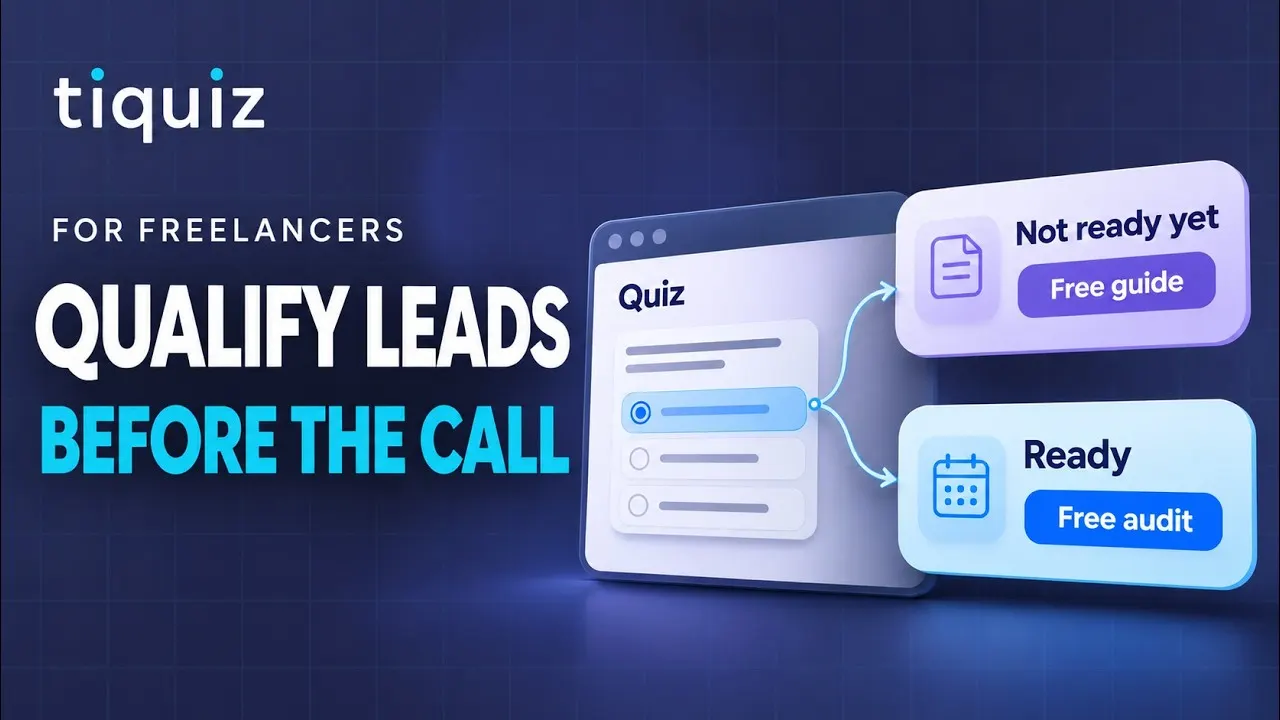
You ask, in writing, the questions you'd ask at the start of a call anyway. Depending on the answers, the quiz shows one of two results, and each result leads to a different next step.
| What their answers say | What the result gives them | What the button offers | Your time |
|---|---|---|---|
| Their project isn't ready | What's really in the way, and three things to do this week | A free guide | Zero minutes |
| Their project is ready | What's missing before they launch | A call | One call, with someone who can buy |
Nobody sorted anything by hand. And nobody got turned away: the person whose project isn't ready leaves with something useful instead of a "come back later."
Why two profiles and not four? For Gwenn's quiz, the AI suggested three. We kept two, because the decision is simple: ready, or not yet. The rule fits in one sentence: as many profiles as you have different next steps to offer. With only two next steps, a third profile just complicates your emails.
Gwenn's example, question by question
Gwenn is a freelancer. She builds funnels, ads and quizzes for her clients. One of them is Jocelyne, an author whose case study is on this blog (285 leads in 9 days).
With her permission, we imagined the quiz she could build to find her own clients. Its title: "Are You Ready for Meta Ads, or About to Pay Facebook for Likes?"
In Tiquiz, she wrote two things:
- who it's for: entrepreneurs, authors and coaches who want to find clients with ads;
- what she offers at the end: a free audit for people whose business is ready, a free guide for those just starting.
The AI wrote the rest: the title, the four questions, the results. Here are the questions, and what each one tells her.
| The quiz question | What it reveals |
|---|---|
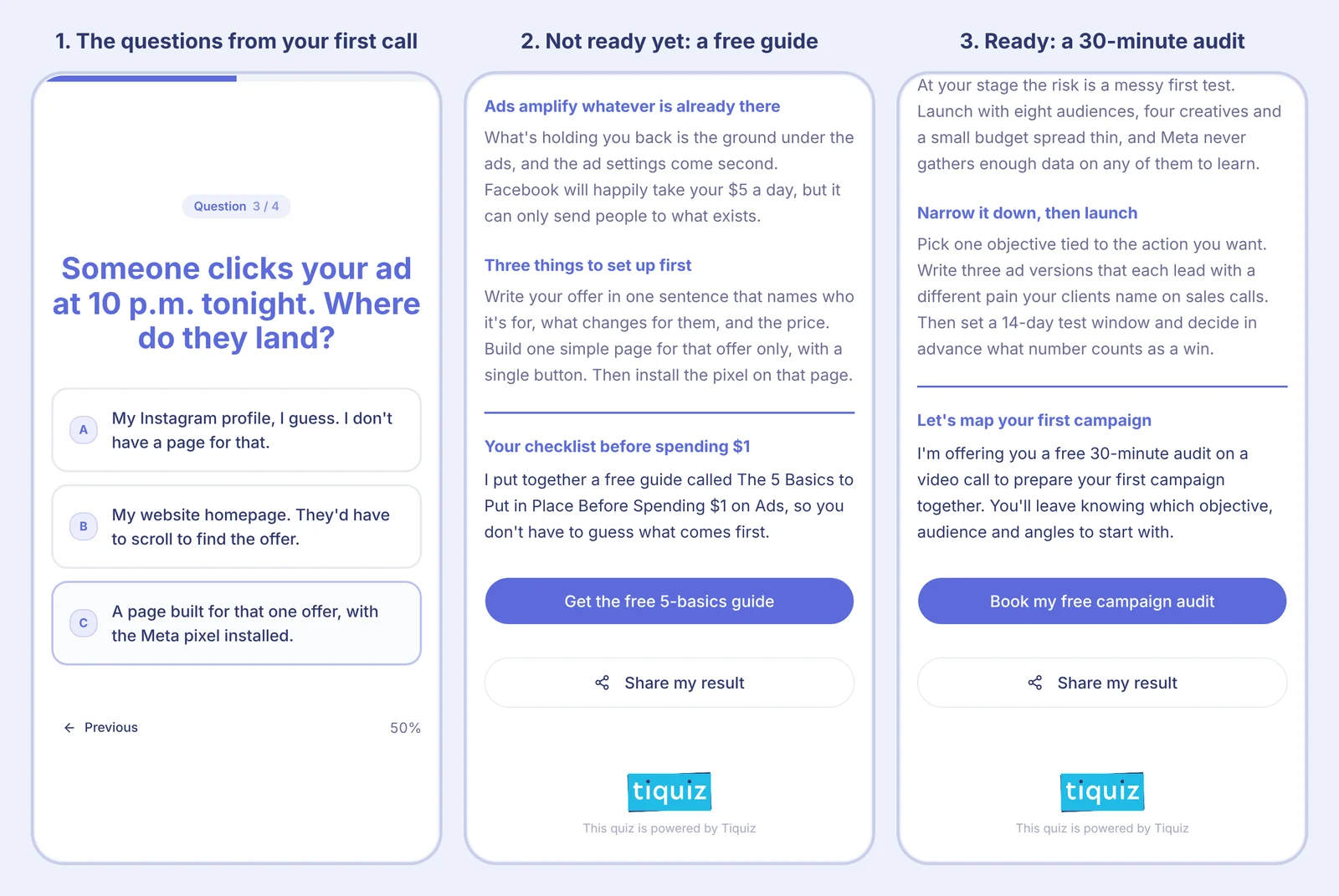
| A stranger at a dinner party asks what you sell. What happens? | Whether the offer is clear, and whether strangers have already paid for it |
| Be honest. What's your history with Meta ads so far? | Where they're starting from: never tried, a few boosted posts, or a real campaign |
| Someone clicks your ad at 10 p.m. tonight. Where do they land? | Whether there's a page built to turn a click into a client |
| What could you spend on ads every month for 3 months without losing sleep? | Whether the budget can carry a real test |
These are the questions Gwenn would ask on a call. Here, the visitor answers them alone, in two minutes. At the end, they leave their first name and email to read their result.
Three things make these questions work:
- They're about facts. "Where do they land" takes no thinking. "Are you motivated?" sorts nobody.
- The answers are written in the prospect's own words. "I've hit Boost post a few times. Got likes. Got zero clients." Anyone who's lived it recognizes themselves, and keeps going.
- Every answer leans toward one path. None is decoration.
One clarification: ads are Gwenn's trade. Your quiz doesn't need ads to work. A link in your bio, your email signature or your posts is enough to start.
Path 1: the person whose project isn't ready
In Gwenn's quiz, this profile is called "The Foundation Builder." This person doesn't yet have an offer that strangers have paid for, or a page to send them to.
The result doesn't say "you're not ready." It says what's in the way, and what to do:
- What's going on: "You tell yourself you'll run ads once things are a bit more settled."
- The real cause: "Ads amplify whatever is already there." Facebook can only send people to what exists.
- What to do: three things to set up first. Write the offer in one sentence, build one simple page for it, install the pixel on that page.
- The next step: a "Get the free 5-basics guide" button, which leads to a free guide on Gwenn's blog.
Then this person receives four emails, over five days, that help them lay the groundwork. For free.
Gwenn hasn't taken a single call. And this person has moved forward. The day their offer is ready, they'll know who helped.
What you can give on this path: a guide, a checklist, an article, a video, a template to fill in. One test only: the person has to be able to use it without you. That's what makes this path something other than a waiting room.
Path 2: the person whose project is ready
Second profile: "The Launch-Ready Pro." This person has an offer that sells, a page for it, and a budget set aside. What's left is the first campaign.
The result shows what's missing before they launch: a narrow first test, with one objective and a win condition decided in advance. Then the button offers a free 30-minute audit.
If they don't book right away, the emails take over:
- the first one goes out right after the quiz;
- the last one, five days later, offers the audit again.
The AI wrote them, from the quiz and the offer. Gwenn reads them over and changes what she wants. Each profile has its own sequence: nobody receives the other profile's emails.
For what goes into each email, see the post-quiz email sequence, with examples, and how Tiquiz sends those emails without another tool.
A detail that keeps people from dropping off: the button link can carry the person's first name and email, so your calendar page opens already filled in. Calendly, Cal.com and TidyCal accept it. All that's left is picking a time.
Before the call: every lead's record
When a ready person comes in, Gwenn opens their record in Tiquiz. Here is Camille's (a demo lead).
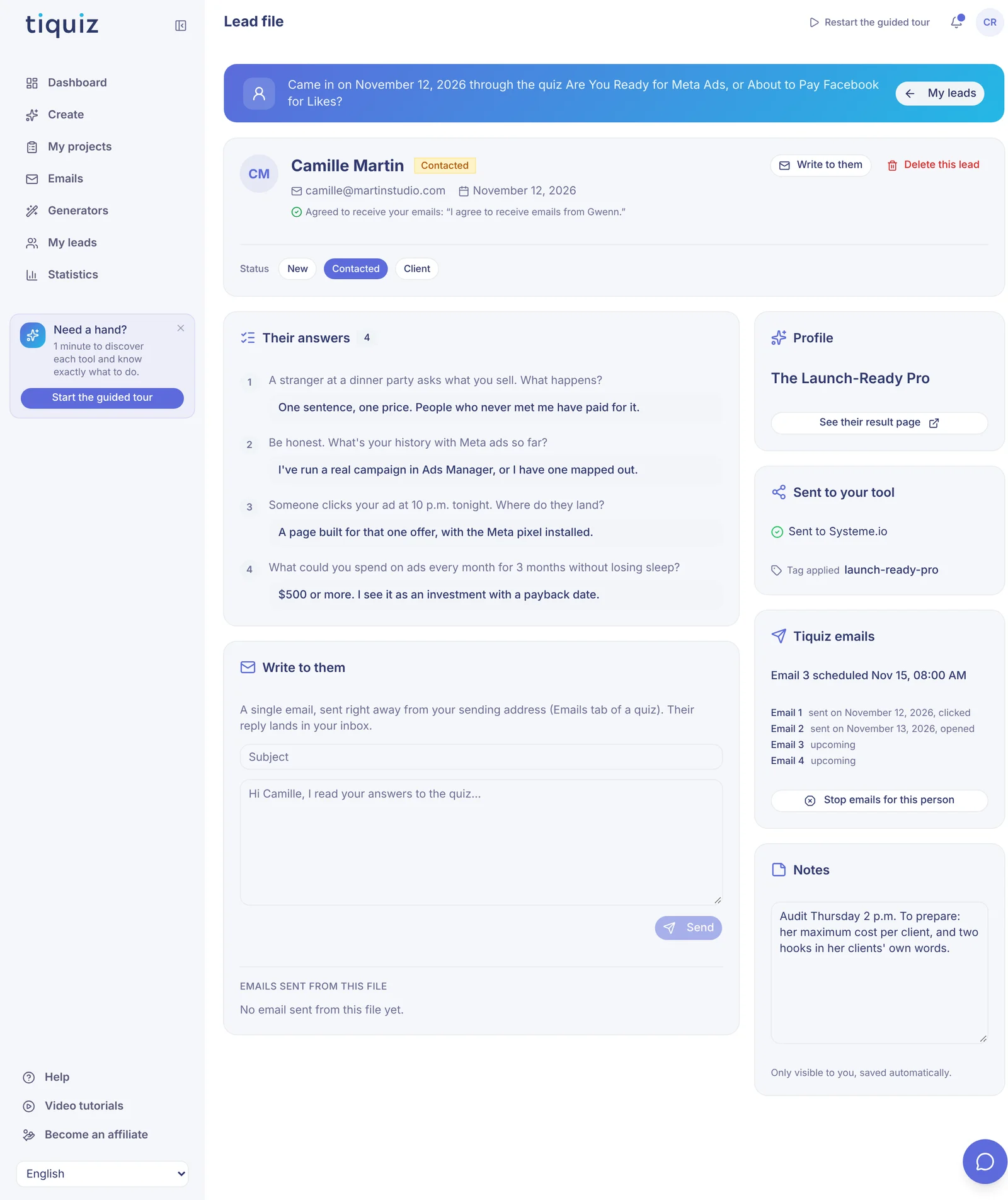
Everything you need to prepare the call fits on one screen:
- their answers, question by question: the offer already sells, the page exists, the budget is set;
- their profile, with a link to the result page they read;
- the emails they've received, the ones they opened, and the ones still to come;
- a field to write to them straight from the record;
- notes, visible only to you: what you discussed, what's left to prepare;
- their status: new, contacted, customer.
Gwenn shows up to the audit already knowing where Camille stands. The first ten minutes of a discovery call, the ones spent on basic questions, have already happened.
How this screen works in full is covered in managing your quiz leads.
This lead-by-lead follow-up is for people who sell a one-to-one service: freelancers and coaches, for example. If you sell a course or a product, you don't need it (see below).
Build yours in five steps
- Write down the questions you always ask on a first call. Keep the ones whose answer changes what you offer. Four to six is enough.
- Write your two next steps before you write the quiz. What you offer someone who can buy (a call, an audit, a quote). What you give someone who can't yet (a guide, a checklist, an article).
- In Tiquiz, write two sentences: who it's for, and what you offer at the end. The AI writes the title, the questions and the results. Delete the extra profile if there is one. The step-by-step is in create a quiz with AI.
- Reread each result with one question in mind: does this person leave with something useful, even if they never buy?
- Turn on follow-up emails, one sequence per profile, and read them before you switch them on.
If you don't know which questions to start with, here's a starting point by trade:
| You are a | A question from your first call | Project not ready: you give | Project ready: you offer |
|---|---|---|---|
| Web designer | Are your copy and photos ready? | The list of what to gather before a website | A scoping call |
| Business coach | How many clients have you worked with in the last six months? | An exercise to clarify their offer | A discovery session |
| Social media manager | Who posts today, and how often? | A content calendar to fill in | An audit of their accounts |
| SEO consultant | Does your site already get visits from Google? | The basic settings to check on their own | A 30-minute audit |
When this system is no use to you
A quiz that sorts people before the call isn't the answer to everything.
- You sell a course or a product. You don't need calls, or to follow each lead one by one: the quiz can sell directly, from the result and the emails.
- You get three inquiries a month. Don't sort them: talk to all three. A quiz will first help you attract more.
- You offer everyone the same thing. If both paths lead to the same button, you've built a longer contact form.
- You're counting on the quiz to get found on its own. You have to show it: in your posts, your bio, your email signature, your homepage.
The question to ask yourself tonight
One quiz, two paths. People whose project isn't ready get help, without costing you an hour on a call. People whose project is ready show up with their answers. And you spend your time with the right people.
So ask yourself one question: what do you always ask on the first call?
Those questions are your quiz.
Write my quiz in two sentences
FAQ · the quiz funnel for freelancers
How many questions should a qualification quiz have?
Four to six. Enough to tell a ready project from one that isn't, few enough that people finish in two minutes. Gwenn's quiz has four.
Are two profiles enough?
Yes, if your decision is binary: you can help this person now, or not yet. Add a third profile only if you have a third next step to offer, for example a lighter offer for small budgets.
What if someone whose project isn't ready still wants to talk to me?
They can: they reply to one of the emails, and the reply lands in your inbox. The quiz closes no door. It only avoids offering a call to someone it wouldn't help today.
Do I need to run ads for the quiz to work?
No. In the example, ads are Gwenn's trade, not a requirement. A link in your bio, your posts, your email signature and your homepage is enough to get your first answers.
Can I do this on the free Tiquiz plan?
To test it, yes: the free plan gives you one quiz, a record for every lead, 10 visible leads per 30 days and one follow-up email per profile. For a four-email sequence per profile like Gwenn's, you need a paid plan, from $17 a month (5 emails per profile). The details are on the pricing page.
Can my contacts also go to my email tool?
Yes. Tiquiz sends every contact to GoHighLevel, to Systeme.io or to a webhook, with one tag per profile. You can also keep everything in Tiquiz: lead capture, follow-up emails and every lead's record are already there.