The video walks through Ethan's quiz and emails. This article goes further: you'll see how to find your own profiles, which questions to ask, what to write in each result, what to put in each email, and when to offer the call.
If the term "quiz funnel" is new to you, start with the definition and the research that explains why it works.
The problem: the same emails for people who aren't living the same thing
Ethan is a coach. He works with women who have already built a business and feel it no longer quite fits them. He offers one-on-one coaching, and he only wants to talk about it with the people for whom the timing is right.
Ethan is an example built to show the method. His quiz, though, is a real quiz, created in Tiquiz, and everything quoted here comes from it.
The people who find him don't all have the same story:
- one has a business that works, and she no longer recognizes herself in it;
- another has clients who keep asking for the work she wants to stop doing;
- a third has several projects and can't choose;
- the last one is just getting started.
If he sends all of them the same emails, none of them will feel understood. And that's exactly what a coach does when everyone gets the same PDF guide, then the same sequence, then the same link to the calendar.
Coaching sells on one specific feeling: "this person gets what I'm going through." A discovery call creates it, but it costs you an hour, and many of the people who book aren't at the right moment. A quiz creates that feeling before the call, for everyone, without you in the room.
The principle: one quiz, four profiles, a single offer
Ethan sells one thing: his one-on-one coaching. He doesn't have four offers for four profiles. What changes from one profile to the next is the path: the words of the result, the free resource, the advice in the emails, and the way the call is introduced.
| The person | Her result | What holds her back | The free resource |
|---|---|---|---|
| Hannah | You've Outgrown the Business You Built | Loyalty to the woman who launched it | A 12-minute audio |
| Sarah | Your Work Moved On. Your Offer Stayed Behind. | Fear of losing the clients of the old offer | A 15-minute video |
| Ashley | Three Good Ideas and One Pair of Hands | The decision she keeps postponing | A 10-minute audio |
| Megan | You're Pouring the Ground Floor | Three basics that aren't set yet | A 20-minute video |
That's the difference with a quiz that points to several products, as in Gabriel's example and his four tools, or to several levels, as in Thomas and his three courses. Here, the quiz doesn't choose the offer. It chooses how to talk about it, and it decides who doesn't hear about it.
If you're torn between profiles and a score, the rule is on the personality or scored quiz page. For a coach, profiles almost always fit: your clients aren't more or less advanced on a scale, they're held back by different things.
Finding your profiles: start from what holds your clients back
One question does most of the work: what holds back the people you coach? Your profiles are in the answer.
The most common mistake is to split an audience by what shows from the outside: age, job title, revenue, years in business. That produces profiles nobody recognizes. "Established business owner" makes no one nod. "Your work moved on, your offer stayed behind" does.
Here's how to find yours in an hour, without making anything up:
- Go back through your last ten discovery calls, or your last ten clients. For each one, write the sentence they used to explain why they hadn't moved yet. Their words, not yours.
- Group the sentences that sound alike. You usually end up with three to five piles. Each pile is a profile.
- Give each profile a title the person could say about themselves. An image, not a category. "Three good ideas and one pair of hands" rather than "the scattered one."
- Write what holds each one back in a single sentence. It's the heart of the result, and the subject of the third email.
- Add the profile of the person for whom it's too early. You already meet them on discovery calls, and you know they won't sign. You might as well tell them respectfully, and give them something to move forward with.
A simple test to check your profiles hold up: hide the titles and reread the descriptions. If you can't tell which one goes with which profile, they're too close. Merge them.
Questions that describe real life
In Tiquiz, Ethan described the people he works with and what he gives at the end of the quiz. To the question "Do you already know which results your quiz should offer?", he answered yes, picked four, and wrote one line per situation. The AI wrote the rest in two minutes: eight questions, and a complete result per profile.
What stands out in these questions is that none of them asks the person to rate herself. They describe a moment, and she says what happens in it.
| The quiz question | What it measures |
|---|---|
| Sunday evening, you're thinking about the week ahead. What weighs on you most? | What's heavy in her week |
| A client thanks you warmly at the end of a project. What goes through your mind? | How she feels about the work she delivers |
| What does your website or LinkedIn bio say about you right now? | The gap between what she does and what she shows |
| Which sentence have you caught yourself saying lately? | The belief that holds her back |
| If you changed something big in your business tomorrow, who would you worry about first? | Her main fear |
Each question has four answers, and each answer counts toward one profile. Take the one about the sentence she keeps saying:
| The answer | It counts toward the profile of |
|---|---|
| "I should be grateful. It's working." | Hannah |
| "Sure, I can do that for you," while thinking I'd rather not. | Sarah |
| "I just need to get through this month, then I'll decide." | Ashley |
| "Once I have more clients, I'll figure out the rest." | Megan |
Three rules for writing yours:
- A moment, not a judgment. "Sunday evening, you're thinking about the week ahead" gets answered without thinking. "Do you feel fulfilled in your business?" asks the person to do the coach's job.
- Answers written in their words. The best answers are sentences you've heard in sessions. When the person reads theirs, they think "that's exactly me," and that feeling is what carries them to the end.
- No answer that feels shameful. "Not knowing where next month's clients will come from" is easy to pick. If an answer makes the person look like a failure, they'll pick another one, and your quiz will land on the wrong profile.
Eight questions here means about three minutes. That's the high end: every question has to separate at least two profiles, or it goes. The step-by-step is in create a quiz with AI.
A result page that helps before it sells
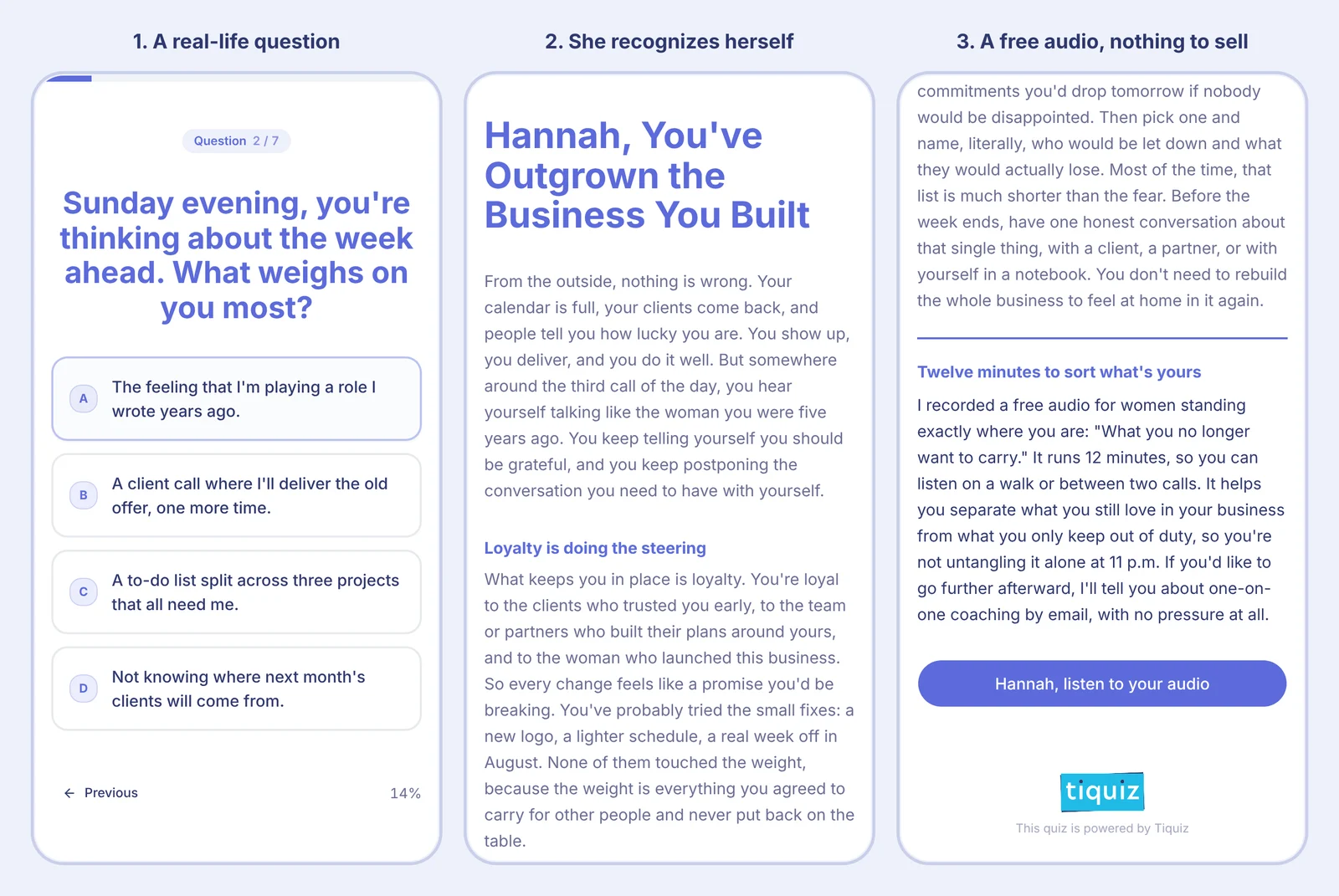
Take Hannah. Her result is called "You've Outgrown the Business You Built." In Tiquiz, every result follows four beats, and here's what they say for her.
| The beat | Its job | For Hannah |
|---|---|---|
| Where you are | She recognizes herself | "From the outside, nothing is wrong." Her calendar is full, her clients come back. And around the third call of the day, she hears herself talking like the woman she was five years ago. |
| Why | She understands what holds her back | "Loyalty is doing the steering": every change feels like a promise she'd be breaking, so she tries small fixes that never touch the weight. |
| One thing to try | She leaves with something to do | Write down three commitments she'd drop tomorrow if nobody would be disappointed, pick one, and name who would actually be let down. |
| What's next | The resource arrives as the logical next step | A 12-minute audio, "What you no longer want to carry," to listen to on a walk. Free. |
Look at what's missing: no price, no program, no "Book a call" button. At the end of her result, Ethan sells nothing. He gives an audio. He only says, in one sentence, that he'll tell her about one-on-one coaching later, by email, with no pressure.
That's a choice, and it holds up. Someone who just recognized herself in a text hasn't decided to hire a coach yet. She's only learned something about herself. Offering a call at that instant asks for a commitment before you've done anything for her. Twelve minutes of audio is the first thing you do for her.
One detail matters in the third row of the table: the step can be done that same evening, without buying anything and without Ethan. A result that says "you need coaching" helps no one. A result that says "write down three commitments and name who you'd let down" proves the coach knows the territory.
The full structure of a result page is laid out in sell with a quiz.
One resource per profile, instead of one lead magnet for everyone
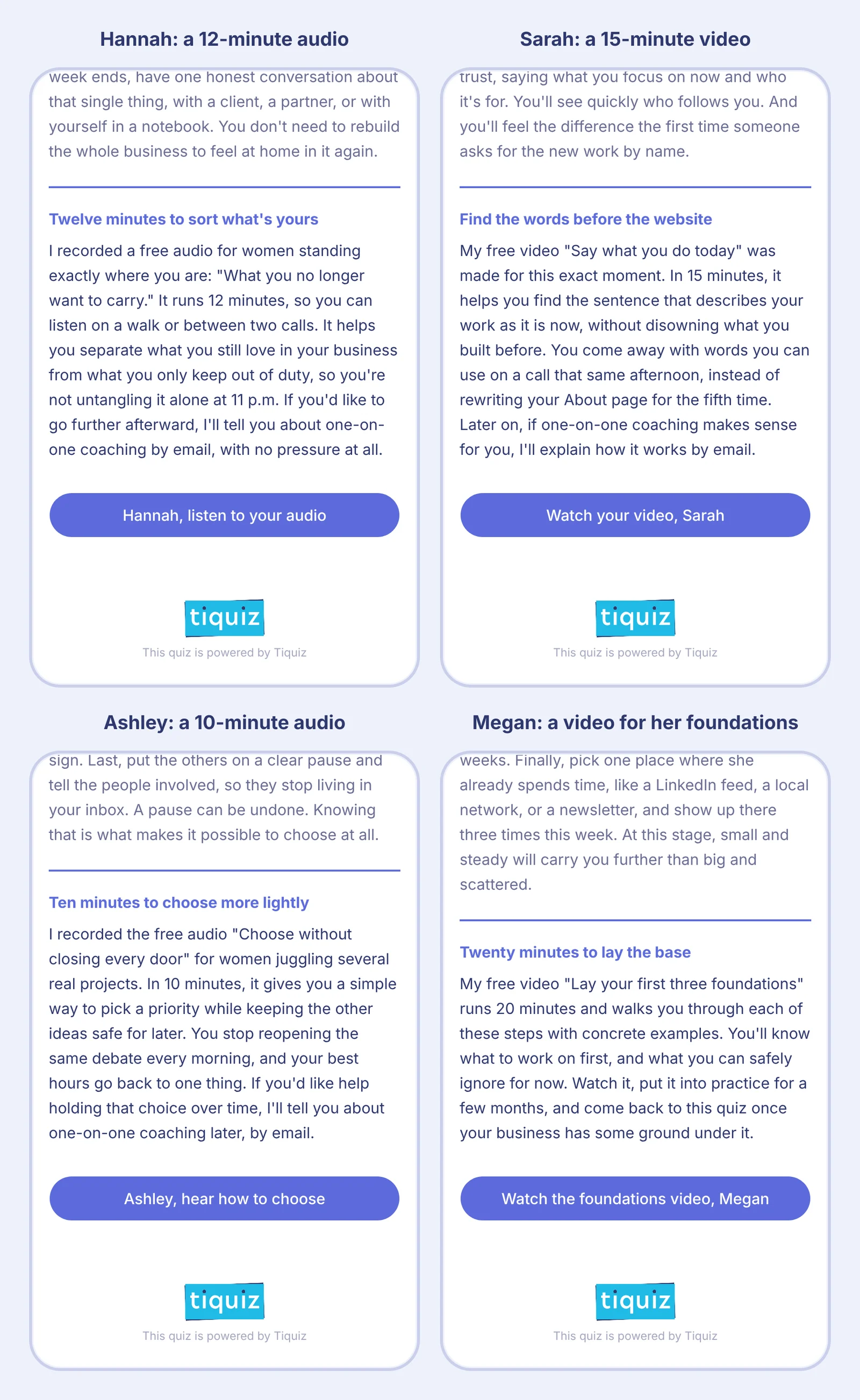
Sarah, whose clients keep asking for the old work, gets a video: how to say what she does today without disowning what she built. Ashley, with three real projects, gets another audio: choosing without closing every door. Megan, who's just starting, gets a video on laying her first three foundations.
Four resources is four times the work of a single guide. Three guidelines to keep it doable:
- Short. Ten to twenty minutes. A resource people finish beats a course they download.
- In the format that fits the blocker. Ethan chose audio for what needs thinking (what you no longer want to carry, how to choose), and video for what needs showing (how to introduce yourself, where to start).
- About one single move. Each resource extends the step from the result. It doesn't tell the story of the coach's method.
If you only have one resource today, start anyway. Give it to every profile and change only the sentence that introduces it. You'll record the others once you know which profile shows up most. More format ideas are in lead magnet ideas for coaches.
The emails: five beats, and one sequence per profile
The rest happens by email, and that's where Ethan puts the most care. He has no email marketing tool. In his quiz's Emails tab, he turns on Tiquiz emails, says what he wants to offer (a free thirty-minute video call), and the AI writes one sequence per profile.
Each sequence has five emails, which follow five beats:
| When it goes out | Its beat | What it contains | |
|---|---|---|---|
| 1 | Right after the quiz | The result | It recalls the profile and the resource, and adds what the page didn't say |
| 2 | 1 day later | One piece of advice | Something to do right away, specific to that profile |
| 3 | 3 days later | What holds her back | The sentence she keeps repeating, and why it blocks her |
| 4 | 5 days later | The offer | The invitation to the call, in the words of her profile |
| 5 | 7 days later | Staying in touch | A way to keep the connection, whether she booked or not |
Those delays are the ones Tiquiz suggests by default. Ethan kept them, and he can change the delay of each email. The emails after the first one go out on the lead's local time, between 8 a.m. and 8 p.m.: nobody gets coaching advice at three in the morning.
The AI writes, and Ethan rereads every email. He edits by clicking in the text, the way you would in a word processor. Don't skip that step: these emails go out under his name, and his clients need to hear his voice in them.
How it all works is in Tiquiz follow-up emails, and on the follow-up emails page. If you already use Systeme.io or GoHighLevel, each contact lands there with the tag for their profile and you send the same sequence from your own tool: the template is in the post-quiz email sequence.
The second email: four people, four pieces of advice
Let's stop on the second email, the one that goes out the next day. It decides whether the person opens the ones that follow.
| The profile of | The advice in the second email |
|---|---|
| Hannah | An exercise to do after her calls: write one line, the sentence she said on autopilot. And next to it, what she would say today. |
| Sarah | A note to take at the end of each session: what came up in the last ten minutes. |
| Ashley | A test: give her best hours of the week to one project only. |
| Megan | A list, where she writes down every client and how they found her. |
Four people, four pieces of advice. And three things in common, which make this email good:
- It sells nothing. No link to the calendar, no hint about coaching.
- It gives something to do right away, with what the person already has at hand: her calls, her sessions, a sheet of paper.
- It ends by inviting a reply. The people who answer write straight to Ethan, because the reply lands in his inbox. A coach who gets ten replies to that email knows what to talk about in the next ten posts.
The test for your own second email: if the person read only that one, and never anything else from you, would they have gained something?
The fourth email: offering the call at the right moment
The fourth email arrives five days after the quiz. By then, Hannah has received her result, an exercise, and an email about the sentence that holds her back. That's when Ethan offers her a thirty-minute call, free and with no commitment. During that call, they look together at whether coaching is right for her.
Sarah and Ashley get the same invitation in different words, because they aren't held back by the same thing. For Hannah, the call is about what she can set down without letting people down. For Sarah, about how to announce the work she does today. For Ashley, about choosing her project.
Behind the button, Ethan put the link to his online calendar. In the email editor, he clicks the button, picks "Another link," and pastes the address. Calendly, Cal.com, the calendar in his own tool: any booking page works.
Why the fourth, and not the first?
- Because trust gets built in order. Three useful emails, then a proposal. The person who books already knows how Ethan works.
- Because the invitation has a context. "You wrote down the sentence you say on autopilot: let's talk about it for thirty minutes" reads like a next step. "Book your discovery call" in a welcome email reads like an ad.
- Because people in a hurry don't wait. The ones who want to talk right away reply to the next-day email. The invitation to reply is there for that too.
If you run on GoHighLevel and its calendar, the booking can also happen inside your own tool: see from quiz results to booked calls.
Knowing when not to invite: Megan's case
And Megan? Her fourth email says it plainly: "There's no call attached, and that's on purpose." She gets resources to get started. The day her business has grown, she'll know where to find Ethan.
Her result page already said it, without dressing it up: "one-on-one coaching isn't the right step for you today."
Many coaches will find this counterintuitive: turning down a call with someone who might book it. Yet it's the best decision in the whole path, for three reasons.
- Your calendar. Thirty minutes with someone for whom it's too early is thirty minutes taken from the three other profiles. And you walk out with an "I'll think about it."
- Their trust. Someone who is told honestly "this isn't for you right now, here's what will help" remembers it. A year from now, when the business is running, that's the coach they come back to.
- Your credibility with everyone else. A quiz that invites everybody is a contact form in disguise. A quiz that can say "not you, not now" is a real assessment, and the three other profiles can feel it.
In practice, it's simple: the sequence for Megan's profile has a different fourth email. No calendar button, resources instead. Each profile has its own sequence, so you write what you want in each one.
Before the call: you already know what holds them back
Here's what changes for Ethan.
- The people who book have recognized themselves in their result. They don't show up asking "so what exactly do you do?"
- They got help before anyone offered them anything. The call doesn't open with a pitch.
- Before each call, he finds their profile in Tiquiz. In My leads, he clicks the person's address and opens their record: their answers, their profile, his own notes, and a status (new, contacted, client). He already knows what holds them back.
A thirty-minute call where the first ten aren't spent discovering the situation is thirty useful minutes. Ethan raises his odds of talking to the right people. This article doesn't promise a number of clients: that depends on your audience, your offer and the care you put into your writing.
Consent, and the unsubscribe link
On the sending side, a few rules apply by themselves in Tiquiz, and you need to know them to read your numbers.
- The first email goes to everyone who leaves their address: it's the result they just asked for.
- The following ones, the advice and the invitation, go out only if the person checked the consent box on the form. Without it, the sequence stops after the first email.
- Every email contains an unsubscribe link. Someone who clicks it receives nothing more.
The practical consequence: write the sentence next to your consent box with care. "Yes, send me the advice that goes with my result" says what the person will receive, and gives a reason to check it. This article isn't legal advice: email rules vary by country, so check the ones that apply to you.
Build yours in six steps
- Find what holds your clients back. Ten calls, ten sentences, three to five piles. Plus the profile of the person for whom it's too early.
- Decide what you offer at the end. One thing: a free call, a trial session, an assessment. And decide which profiles you offer it to.
- Prepare one short resource per profile, or a single one to start. Ten to twenty minutes, one move.
- In Tiquiz, describe your audience, choose the personality type, answer yes to "Do you already know which results your quiz should offer?" and write one line per profile. The AI writes the questions and the results.
- Reread each result, then take the quiz once per profile. Does the description sound like one of your clients? Can the step be done tonight? Does each path land in the right place?
- Turn on the emails, state your offer, reread the five emails of each profile, put your calendar link behind the button of the fourth, and remove the invitation from the profile you don't want to invite.
Ethan's quiz speaks to women business owners, but the method doesn't depend on the specialty. Here's something to start from:
| Your specialty | Your quiz question | Blockers that make profiles |
|---|---|---|
| Career change coaching | What's really keeping you from changing careers? | Money fears, what family will say, no direction, too many directions |
| Executive coaching | What takes the most energy out of you with your team? | Delegating, deciding, giving hard feedback, hiring |
| Life coaching | What's keeping you from changing what no longer fits? | Guilt, habit, fear of getting it wrong, no time for yourself |
| Health and fitness coaching | Why don't your good resolutions last more than three weeks? | All-or-nothing, schedule, boredom, no markers of progress |
| Business coaching | What's capping your revenue right now? | The offer, visibility, pricing, selling |
These blockers are starting points, not truths: yours come out of your ten calls.
6 mistakes that drive future clients away
- Flattering profiles. "The Visionary," "The Strategist," "The Creative": everyone is pleased, nobody learns anything. A good profile names a blocker, kindly.
- A result that ends with "book your call." The person feels pulled into a funnel. Give first, offer later.
- The same sequence for every profile. That's the starting problem, moved one step down. If you only have time to write one thing per profile, write the second email.
- Advice nobody can apply alone. "Work on your mindset" can't be done on a Tuesday night. "Write down one sentence after each call" can.
- Inviting everyone. Your calendar fills with calls that go nowhere, and you conclude the quiz doesn't work.
- Not rereading what the AI wrote. A coach sells a voice. An email that doesn't sound like you gets spotted by the second sentence.
When a quiz won't bring you clients
A quiz isn't the right answer to everything.
- You don't know yet who you coach. Without clients, you have no sentences to group, so no profiles. Have ten conversations first. That's the advice Ethan gives Megan, by the way.
- Nobody sees your quiz. A quiz turns visitors into conversations, it doesn't create visitors. Put it in your bio, at the end of your posts, in your email signature, and bring it up when someone asks "so what exactly do you do?"
- Your coaching fits everyone the same way. It's rare, but it happens. In that case, one good email does the job.
- Your topic is intimate or painful. Health, grief, relationships: a quiz can work, provided it diagnoses nothing, judges no one and doesn't offer to share the result.
- You want clients this week. Ethan's path takes seven days per person. For this week, call your past clients.
If you sell services rather than coaching, the same mechanism exists in a freelance version: see the freelance quiz funnel.
The question to ask yourself tonight
A single offer, four paths. Each person reaches the call by their own, with the advice that matches what holds them back. And the one for whom it's too early leaves with something to move forward.
If you're a coach or a consultant, ask yourself one question: what holds back the people you work with?
Your profiles are there. Tiquiz writes the quiz and the emails from a few sentences. You can start for free, with one email per profile; full sequences are part of the paid plans.
Write my quiz in a few sentences
FAQ · getting coaching clients with a quiz
How do you get coaching clients with a quiz?
You identify three to five blockers that hold your clients back, and each one becomes a quiz profile. The result page describes the person's situation, names what holds them back, gives one step and a short free resource. One email sequence per profile then delivers a piece of advice, and offers a call in the fourth email, only to the profiles your coaching is right for.
How many profiles should a coaching quiz have?
Three to five. In Tiquiz, you choose two to five results when you create the quiz and write one line per result. Ethan has four, including one for people for whom it's too early. Past five, the descriptions start to look alike and the questions can no longer tell them apart.
Should I offer a discovery call on the result page?
You can, but Ethan's example shows the value of waiting: his result page gives a free resource, and the call is offered in the fourth email, five days later. The person has received three useful messages before the invitation. If your audience already knows you well, you can shorten that, keeping at least one advice email before the offer.
How many emails should I send after the quiz, and how often?
Five emails per profile: the result right after the quiz, then advice at 1 day, what holds the person back at 3 days, the offer at 5 days and a stay-in-touch email at 7 days. Those are the default delays in Tiquiz, and you can change the delay of each email. The details are in Tiquiz follow-up emails.
Does it work without an email marketing tool?
Yes. Tiquiz captures the email, keeps every contact with their profile and sends that profile's sequence itself. If you already use Systeme.io or GoHighLevel, each contact lands there with the tag for their result, and you send your emails from your own tool.
Do the emails go to everyone?
The first one, which contains the result the person asked for, goes to everyone who leaves their address. The following ones go out only if the person checked the consent box on the form. Every email contains an unsubscribe link.
What do I do with people my coaching isn't right for?
Give them a profile of their own, with a real resource and a sequence without an invitation. Ethan writes it in plain words in Megan's email: "There's no call attached, and that's on purpose." You keep your calendar for the right conversations, and that person will know where to find you when the time comes.
Can I do this on the free Tiquiz plan?
To get started, yes: the free plan gives you one quiz, AI writing and one follow-up email per profile, the result email. To send the full sequence of five emails per profile, you need a paid plan, from $17 a month. The details are on the pricing page.