The video shows Thomas's quiz in under five minutes. This article walks through each step so you can build your own: which questions to ask, how to set the score, what to write in each result, which emails to send, and when a quiz won't help you sell.
If "quiz funnel" is a new term for you, start with the definition and the studies behind why it works.
The problem: several courses, one front door
Thomas teaches affiliate marketing. He has three offers:
- a free mini-course, his entry point;
- a full course;
- one-on-one coaching over six months.
Three offers, for three levels. On paper, it's tidy. In practice, everyone arrives through the same link, reads the same page and gets the same emails.
The result:
- the beginner lands on the six-month coaching, when it's far too early. They leave thinking it isn't for them;
- the person who already has an audience gets the basics, which they know by heart. They unsubscribe before ever seeing the offer meant for them.
In both cases, you had the right course. It just never reached the right person.
To make the right offer, you need to know each person's level. You can ask on a call, one person at a time. Or you can ask in writing, everyone at once, with a quiz that counts points.
The principle: a scored quiz, one offer per score range
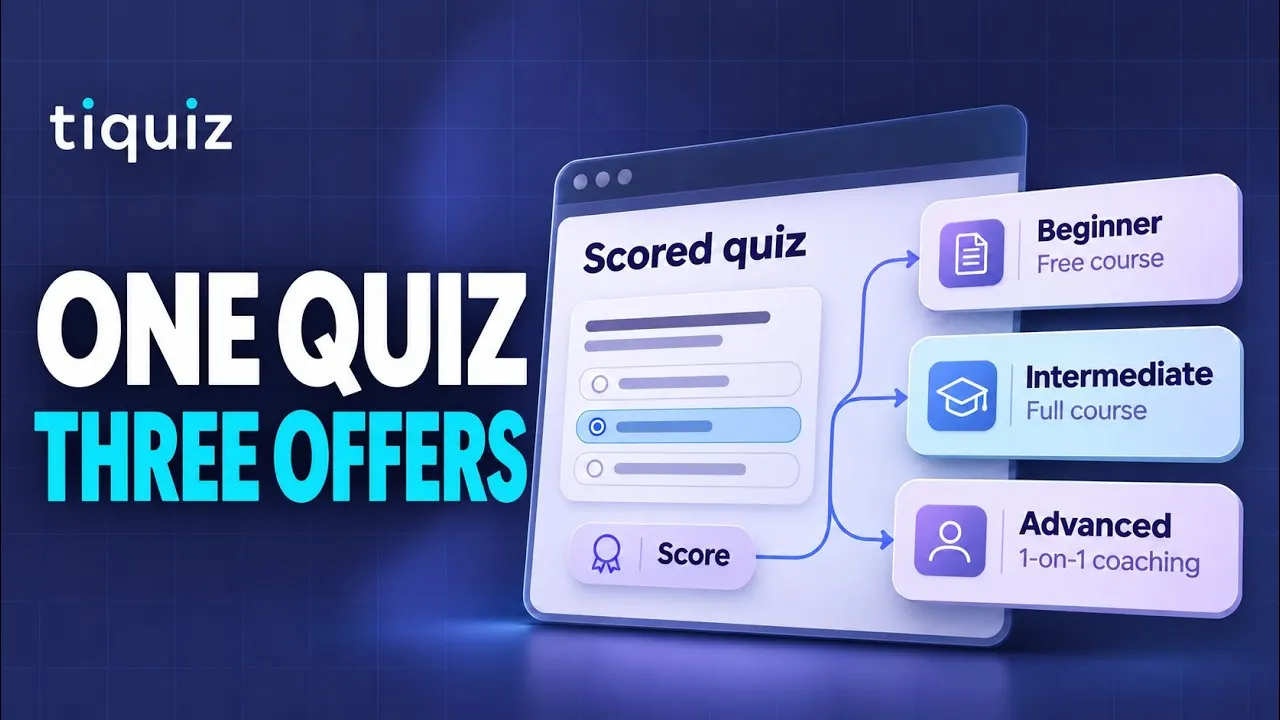
A scored quiz works like a placement test. Every answer earns points. At the end, the quiz adds them up, and the total falls into a range. Each range has a result, and each result has an offer.
| The score | What the result tells them | The offer shown | The tag applied |
|---|---|---|---|
| Low (0 to 7 points) | You're starting out, and here is why everything feels blurry | The free mini-course | affiliate-beginner |
| Mid (8 to 15 points) | You're doing the right things, and here is why it has plateaued | The full course | affiliate-intermediate |
| High (16 to 24 points) | Your system runs, and here is what's missing | The six-month coaching | affiliate-advanced |
The same quiz, and three different destinations. Nobody read the answers one by one, and nobody picked the offer by hand: the score decides.
What makes it sell is the timing. The person sees your offer right after understanding where they stand. They don't have to wonder "is this for me?": their result has just answered that.
Personality quiz or scored quiz: which one sells courses?
There are two ways to assign a result, and they don't answer the same question.
| Personality quiz | Scored quiz | |
|---|---|---|
| The question you ask the visitor | Who are you? | Where are you at? |
| How the result is chosen | Each answer leans toward a profile, and the most chosen profile wins | Each answer earns points, and the total falls into a range |
| What the visitor reads | A profile (for example: the architect, the artist) | A score, with a breakdown by theme |
| Your offers differ by | Need or style | Level |
| Example | Three courses on three different topics | A free course, a full course, a coaching program |
The rule: if your offers form a staircase (people take one before the other), use a scored quiz. If they sit side by side (each one answers a different need), use a personality quiz.
Thomas has a staircase: free, course, coaching. So he chose the score. Both mechanics are explained on the personality or scored quiz page.
Thomas's example: 8 questions, 3 themes, 24 points
Thomas is an example built for this walkthrough: an affiliate marketing teacher with three offers. His quiz is a real one, created in Tiquiz. Its title: "What stands between you and your first recurring commissions?"
In Tiquiz, he filled in four things:
- who it's for: people who want to earn commissions with affiliate marketing;
- his three offers, from the free one to the coaching;
- the type of quiz: scored;
- three themes to assess: offer selection, audience, tools.
The AI wrote the rest: eight questions and three results. Here are the questions, theme by theme.
| Theme | The quiz question | What it measures |
|---|---|---|
| Offer selection | You come across an affiliate program. Which number do you look at first? | Whether the person can read a program |
| Offer selection | You're offered two programs. The first pays $50 once. The second pays $15 a month for as long as the customer stays subscribed. Which one do you take? | Whether they understand recurring commissions |
| Offer selection | How do you spot a program that few affiliates are promoting yet? | Whether they have a method for choosing |
| Audience | Today, how many people can see what you publish or receive your emails? | The size of their audience |
| Audience | You publish a piece of content. What happens in the next 48 hours? | Whether that audience responds |
| Audience | Where can you reach your followers? | Whether they have an email list, or only a social network |
| Tools | What is a CRM, to you? | Whether they have a tool, and whether they use it |
| Tools | A follower clicks your affiliate link but doesn't buy. What happens next? | Whether they follow up, and how |
Each question has four answers, worth 0 to 3 points. Take the second one:
| The answer | Points |
|---|---|
| Honestly, I don't know how to decide | 0 |
| The first, $50 right now feels more real | 1 |
| The second, mostly because I like the tool | 2 |
| The second, if customers stay subscribed for several months | 3 |
Four things make these questions work:
- They put the person in a situation. "Which one do you take?" takes ten seconds to answer. "What is your level in affiliate marketing?" measures nothing: everyone says average.
- No answer is humiliating. "I had never thought about that" is worth zero points, and people still pick it without embarrassment. Someone who feels judged closes the quiz.
- The best answer is never in the same place. In Thomas's quiz, the 3-point answers are sometimes second, sometimes last. Nobody can guess.
- The answers already teach something. Reading "if customers stay subscribed for several months", a beginner learns there is a question worth asking. The quiz teaches before the result even shows up.
From score to offer: how to set the ranges
Eight questions, 3 points at most per question: Thomas's quiz totals 24 points. His three ranges:
- 0 to 7 points: beginner;
- 8 to 15 points: intermediate;
- 16 to 24 points: advanced.
Take Julie. She does well on the three offer selection questions, and less well on the rest: 13 points out of 24, or 54%. She falls into the middle range. Her result screen shows her score, then the breakdown by theme: fairly comfortable with offer selection, weaker on audience.
If your course starts with a video, here's how an interactive video quiz captures leads from it.
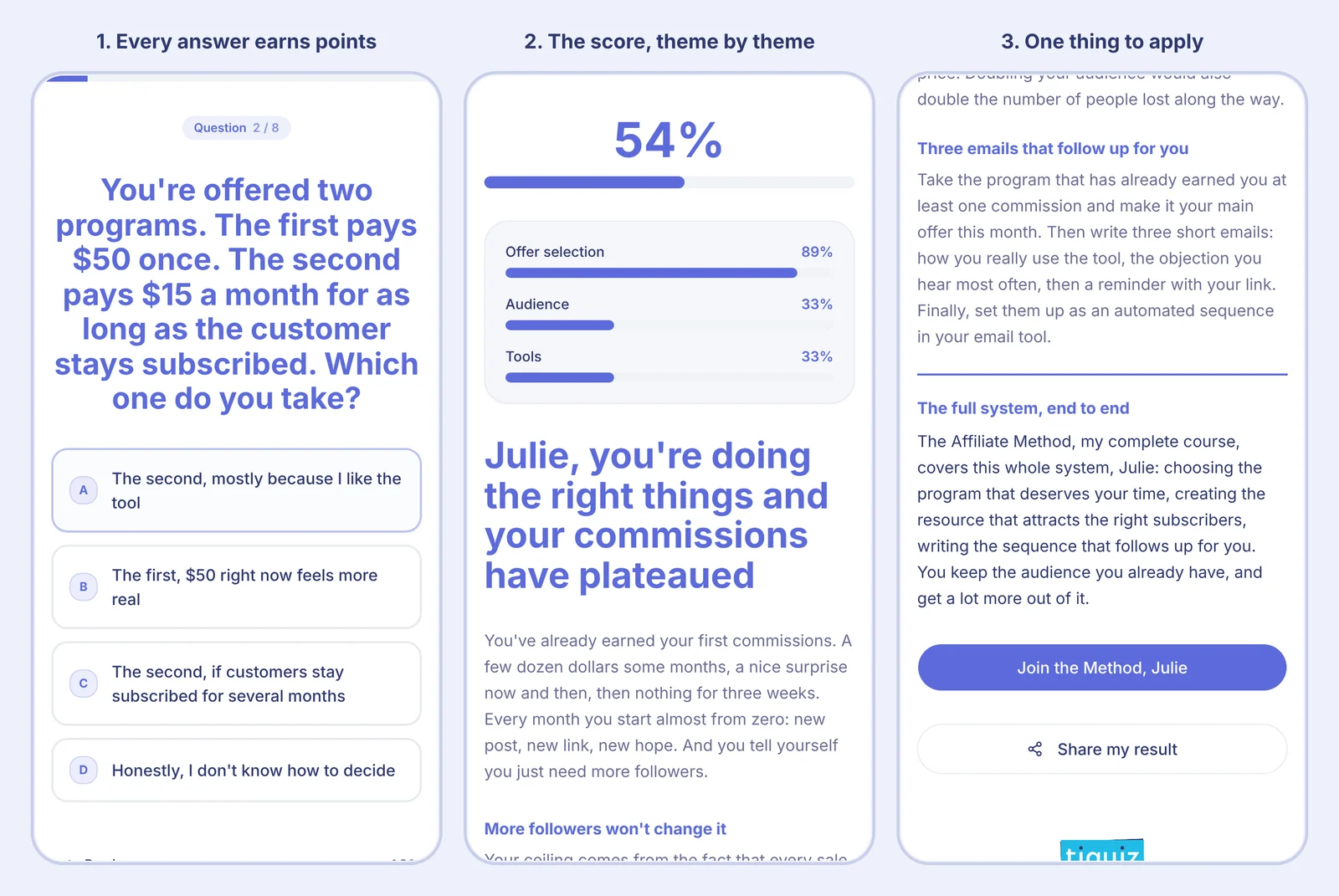
That breakdown matters as much as the score. "54%" doesn't say what to do. "You know how to choose a program, your audience is what's holding you back" gives a direction, and sets up what comes next.
To set your own ranges, three markers:
- Start from your offers, not from the numbers. Ask yourself what the person for whom your full course is the right choice can already do. The answers that describe them give you the bottom of their range.
- Take the quiz three times, answering as a beginner, as an intermediate, then as an advanced person. If two of them land on the same result, move a boundary.
- Check your stats after the first thirty responses. If 80% of people fall into the same range, your questions are too easy, or too hard.
You have no math to do while the quiz runs: Tiquiz adds up the points and picks the result. You can also hide the score, if you'd rather people read only their result.
What every result needs in order to sell
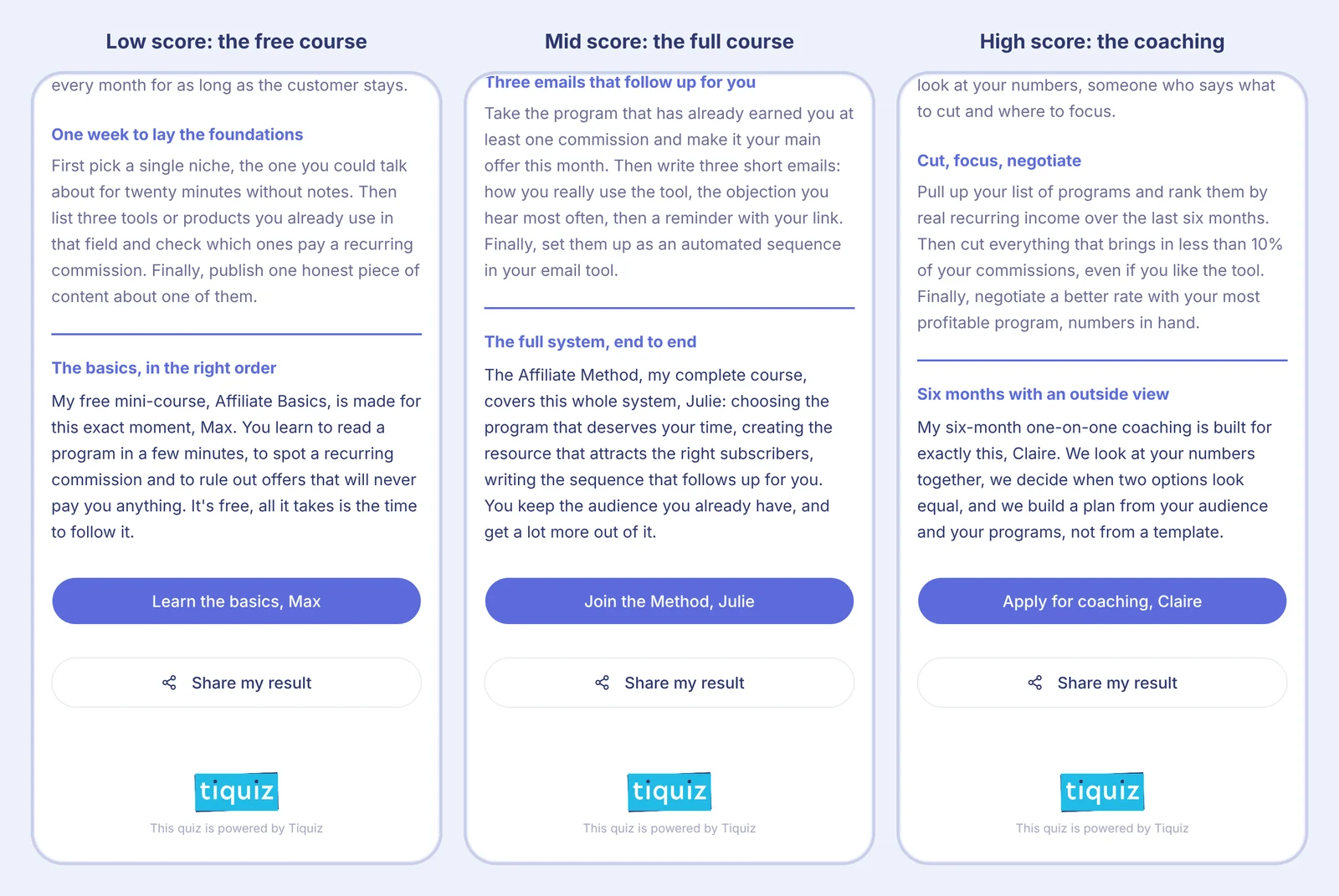
A result made of a score and a "Buy" button doesn't sell. The person has just given you three minutes: they expect something back. In Tiquiz, every result follows four beats. Here is Julie's.
| The beat | Its job | For Julie |
|---|---|---|
| Where you are | The person recognizes themselves | "You're doing the right things and your commissions have plateaued." A few dozen dollars some months, then nothing for three weeks. |
| Why | They understand the real cause | "More followers won't change it." Every sale depends on one piece of content, seen once. Someone who clicks without buying is gone. |
| One thing to apply | They leave with something useful | "Three emails that follow up for you": how she really uses the tool, the most common objection, a reminder with the link. |
| What's next | The offer arrives as the logical next step | The full course covers that whole system. The button: "Join the Method, Julie". |
Look at the order. The offer comes last, after advice Julie can apply on her own. That advice takes nothing away from the sale: it proves Thomas knows his subject, and it shows a piece of what the course contains.
Max, who has a low score, reads something else: why every program looks the same to him, three things to do within a week, then the free mini-course. Claire, who has a high score, reads that her brake is spreading herself thin, and the button invites her to apply for the coaching.
That word changes everything for a high-ticket offer. Thomas isn't selling six months of coaching on a quiz page. He receives applications from people who have already shown their level.
The AI writes these texts, and Thomas reviewed them once. It's the one step you shouldn't skip: a wrong result, even a well-written one, costs you the person's trust.
The share bonus: your visitors spread the quiz for you
Right before the result, Thomas's quiz offers a bonus: an earnings calculator. You enter the product price, the commission and how long the subscription lasts. It tells you what one customer can earn you, and whether the program is worth your time.
To get it, the visitor shares the quiz: on a social network, by email, or by copying the link. That's the Tiquiz share bonus, one option to switch on and one sentence to describe your bonus.
A good share bonus has three qualities:
- it can be used right away: a calculator, a checklist, a template to fill in. A 40-page ebook isn't a bonus, it's homework;
- it relates directly to the quiz: Thomas's bonus answers the question the quiz has just raised (is this program profitable?);
- it's useful at every level, since everyone sees it before their result.
Every share shows the quiz to new people, who are close enough to your audience to be in its circle. Thomas has nothing extra to publish. How it works is covered on the sharing and the bonus page.
After the quiz: one tag per level, one sequence per tag
The result makes the offer once. The emails are what sell it, because few people buy a course the day they discover it.
Thomas works with GoHighLevel. He connected Tiquiz to his account, once. Since then, every person who answers lands in his contacts with a tag:
| The tag | Applied when | What it triggers |
|---|---|---|
| affiliate-beginner | Low score | The result, then the free mini-course |
| affiliate-intermediate | Mid score | The result, then the full course. Two days later, the second email |
| affiliate-advanced | High score | The result, then the invitation to apply |
| bonus-calculator | The person shared the quiz | The earnings calculator |
In GoHighLevel, a tag triggers a workflow. So Thomas set up one workflow per tag. Tiquiz gives you the exact list of tags in each quiz's Automate tab: you have nothing to invent or retype from memory.
Three ways to send those emails, depending on your tools:
- GoHighLevel: one workflow per tag. The step by step is in the 5 workflows to build so a quiz actually sells;
- Systeme.io: same principle, with one automation rule per tag. See the 5 rules to create for every lead;
- no email tool at all: Tiquiz sends the emails itself, one sequence per level, written by the AI and reviewed by you. See follow-up emails.
What goes in those emails? For a course, a short sequence is enough: the result and the offer, one objection handled, one concrete example, a reminder. The full template, email by email, is in the post-quiz email sequence.
Look at what this changes for Thomas. He doesn't read answers one by one. He sends no email by hand. He no longer wonders which offer to show to whom. While he prepares his lessons, someone answers, discovers their score, reads their advice and gets the emails for their level.
The line at the bottom of the quiz: a 40% commission without mentioning it
One last detail. At the bottom of every quiz, there is a line: "This quiz is powered by Tiquiz". That link is tied to the affiliate account of the person who created the quiz, automatically.
On a paid plan, Thomas could remove that line. He keeps it. If a visitor clicks and subscribes to Tiquiz, Thomas earns a 40% commission on every payment, for as long as that person stays subscribed.
For someone who teaches an audience of business owners, that isn't a footnote: some of his students will want to build their own quiz. The program is described on the affiliate page, and the logic of recurring commissions in this article.
Build yours in six steps
- Write down your offers in order, from the most accessible to the most committing. Two are enough to start. If you have no free offer, an article or a video will do.
- Ask yourself one question: what separates the customer of your first offer from the customer of your last? What they know, what they've already done, what they own. Those criteria are your questions.
- Group those criteria into two or three themes. They become the lines of the breakdown the visitor reads under their score.
- In Tiquiz, describe your audience and your offers, choose the "scored" type and enter your themes. The AI writes the questions, the points and the results. The step by step is in create a quiz with AI.
- Review it, then take the quiz three times: as a beginner, as an intermediate, as an advanced person. Check that each one lands on the right offer.
- Plug in the emails: connect your tool or switch on Tiquiz emails, one sequence per level.
If you don't know which themes to choose, here is a starting point depending on what you teach:
| You teach | Three themes to assess | Low score | Mid score | High score |
|---|---|---|---|---|
| Video editing | Shooting, editing, publishing | A mini-course: edit your first video | The full course | Coaching on your channel |
| Business English | Listening, speaking, job vocabulary | Five free lessons | The online program | Private lessons |
| SEO | Technical, content, links | The basic settings checklist | The SEO course | A guided audit |
| Personal budgeting | Tracking spending, saving, investing | A budget sheet to fill in | The 6-week method | One-on-one follow-up |
| Drawing | Line, proportions, color | A 7-day challenge | The full curriculum | Personal feedback on your work |
5 mistakes that stop a quiz from selling a course
- Asking for an opinion instead of a fact. "Do you feel comfortable with email marketing?" sorts nobody. "Who did you email this week?" sorts everyone.
- Letting people guess the right answer. If the 3-point answer is always the longest or always the last, people play to win, and their score means nothing.
- Sending everyone to the same offer. If your three results end with the same button, you wrote a form, not a quiz. The promise of a quiz is advice that changes with the person.
- Writing a result that flatters. "Well done, you're on the right track" gives no reason to buy. A useful result names what's in the way.
- Stopping at the result. With no emails behind it, the person who doesn't buy right away is lost. That's exactly what Julie's result explains to her, about her own affiliate links.
When a scored quiz won't help you sell
A score isn't the right answer to everything.
- You have only one course. The score has nothing to choose between. Use a personality quiz: the offer stays the same, and the angle changes with the person. The method is in sell with a quiz.
- Your courses cover different topics, not different levels. Profiles fit better there too.
- You sell time, not a course. You need to sort people before a call: that's a different quiz, described in the quiz funnel for freelancers.
- Your course doesn't exist yet. Start with a survey, to find out what your audience wants to learn.
- Nobody sees your quiz. A quiz converts visitors, it doesn't create them. Show it: in your bio, your posts, your newsletter, your homepage.
The question to ask yourself tonight
One quiz, three offers, and everything runs on its own. Each person sees the offer made for them, at the moment they've just understood where they stand. And the people who apply for your highest-priced offer have already shown their level.
So ask yourself one question: what separates the customer of your first offer from the customer of your last?
Those criteria are your questions.
Write my quiz in a few sentences
FAQ · selling online courses with a quiz
Can you really sell an online course with a quiz?
Yes, as long as the quiz is there to guide people, not just to collect emails. The quiz measures where the person stands, their result explains what's holding them back, then shows the course that matches their level. The emails sent afterward do the rest, because few people buy on the same day.
How many questions should a scored quiz have?
Between six and ten. You need at least two per theme for the breakdown to mean something, and few enough that people finish in three minutes. Thomas's quiz has eight, across three themes. On quizzes built with Tiquiz, 78.8% of people who start a quiz finish it (our numbers across 4,354 quiz starts).
Personality quiz or scored quiz, how do I choose?
Look at what sets your offers apart. If it's the level (beginner, intermediate, advanced), use a score. If it's the need or the topic, use profiles. With a single course, use profiles: the offer stays the same, and each profile discovers it from the angle that matters to them.
Should I show the visitor their score?
Most of the time, yes: a number and a breakdown by theme make the result credible. If your topic is sensitive, or if a low score could discourage people, you can hide it in Tiquiz. The person then reads only their result.
What if a beginner still wants my full course?
Nothing stops them. The result recommends an offer, it rules none out. You can present the next course in your emails once the first one is done, and the person can always reply to ask their question.
Does it work without an email marketing tool?
Yes. Tiquiz captures the email, keeps every contact and sends one sequence per level itself. If you already use GoHighLevel or Systeme.io, each contact lands there with the tag for their level, and you send your emails from your own tool.
Can I do this on the free Tiquiz plan?
To test it, yes: the free plan gives you one quiz (personality or scored), AI writing, one connection to your tool, 10 visible leads per 30 days and one follow-up email per level. To remove the Tiquiz line, lift the lead limit and send up to 5 emails per level, you need a paid plan, from $17 a month. The details are on the pricing page.